Problems
5 to 30 minutesOne question, the data you need and nothing more, graded the moment you submit. Calculations, diagnoses, design choices, log picks and Python tasks, each with a worked solution.
FreeLeetCode for petroleum engineering
Practice problems in every petroleum engineering discipline, from five-minute calculations to week-long field scenarios, all graded against a hidden true answer.
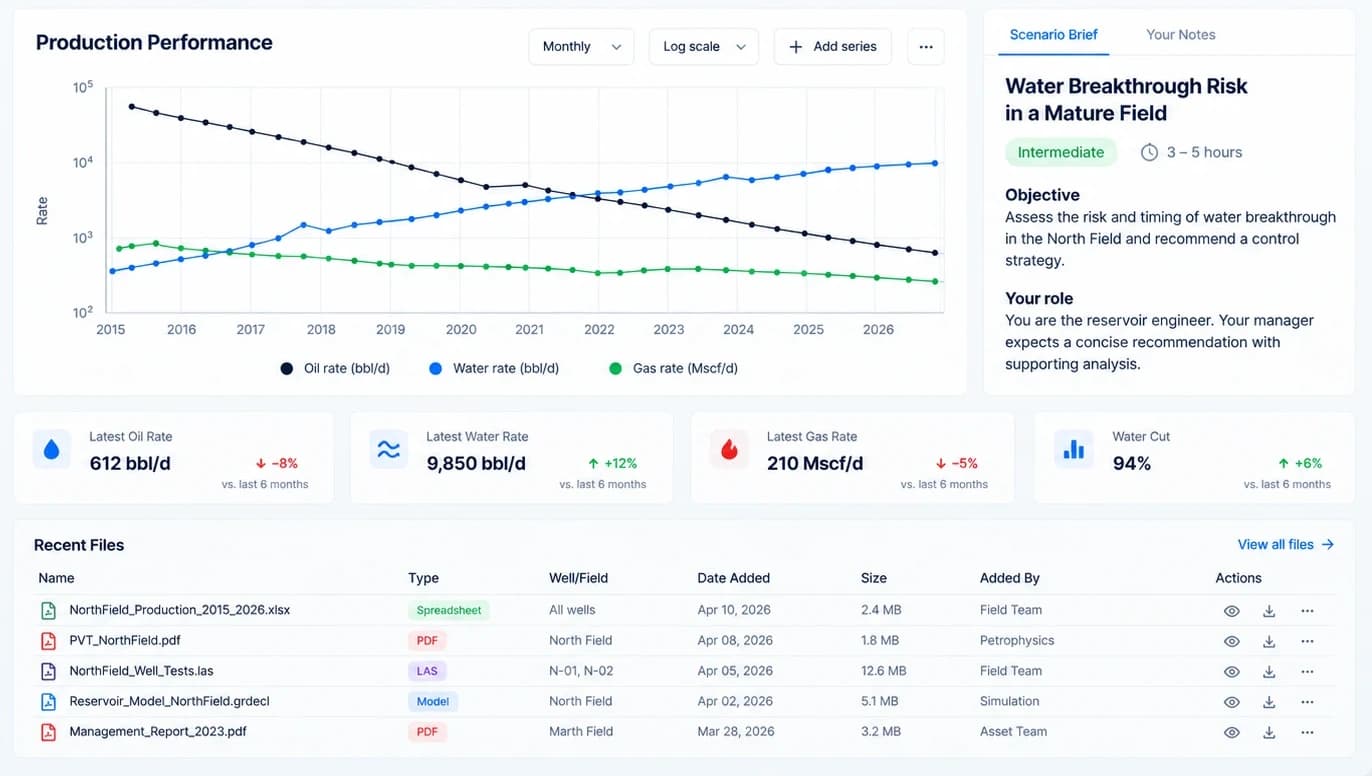
Water Breakthrough Risk in a Mature Field
In progressRead the brief. Sarah needs a recommendation for Thursday’s partners meeting, and you have $60,000 for extra studies.
Why it exists
A drilling engineer with seven years behind them has taken a kick and filled in a kill sheet with the rig waiting. A production engineer has chased a well that would not lift. A reservoir engineer has watched water break through two years early. That is what the job advert means by experience.
Students meet those problems only after someone hires them, and nobody hires them until they have met them. PetroLabb hands you the problems first, in every discipline.
Disciplines
Ten disciplines, each with Easy, Medium and Hard problems tagged by the role they prepare you for. Start where your degree is strong, then go where your first job will push you.
The 9⅝ in shoe is set and the leak-off test is in. The next section crosses a pressured shale, and the superintendent wants to know how heavy you can go before you break the formation at the shoe.
Maximum mud weight for the next section
Drilling and well engineers
Reservoir engineers
Production and artificial lift engineers
Completion and intervention engineers
Petrophysicists and formation evaluators
Process, facilities and subsea engineers
Well integrity and intervention engineers
Engineers who work with geologists
Planners, commercial and reserves engineers
Engineers who code
Try one now
These are the Easy end of the bank: one formula each, the kind an interviewer expects you to do on a whiteboard. Answers within 2% of the true value pass, the same rule the platform uses.
On the platform the inputs change with every attempt, so a remembered number is worth nothing. What you keep is the method.
You are drilling a vertical well with water-based mud. Before the next trip the company man asks what pressure the mud column is holding against the formation at TD.
Two ways to practise
One question, the data you need and nothing more, graded the moment you submit. Calculations, diagnoses, design choices, log picks and Python tasks, each with a worked solution.
A week at a fictional operator, compressed. An email from a manager, a data room of messy files, a budget, a clock, something that changes halfway through, and a debrief that shows what was really going on.
One new problem each morning, rotating through the disciplines.
Ordered sets such as a graduate drilling interview or a first year in production.
Timed rounds for universities and SPE student chapters, with leaderboards.
Every problem shows the working, reviewed by a practising engineer.
Everything you solve builds a record you can show an employer.
Scenarios
Every scenario, in every discipline, runs through the same steps: a briefing, an investigation, checkpoints you commit to, a twist halfway through, and a debrief. This one is a reservoir scenario. Scroll through it.
Monday 08:12 · Briefing
Ngozi at Delta Basin Energy writes that DB-7 has fallen from 2,400 to 1,300 bbl/d since March and the water cut has jumped. Partners meet Thursday. Is it the reservoir or the well, and can it be fixed?
Ngozi, Asset Manager
Delta Basin Energy · Mon 08:12
DB-7, need an answer before Thursday
DB-7 has gone from 2,400 to 1,300 bbl/d since March and the water cut has jumped.
Partners meet Thursday. Reservoir or well, and can we fix it?
N.
Investigate
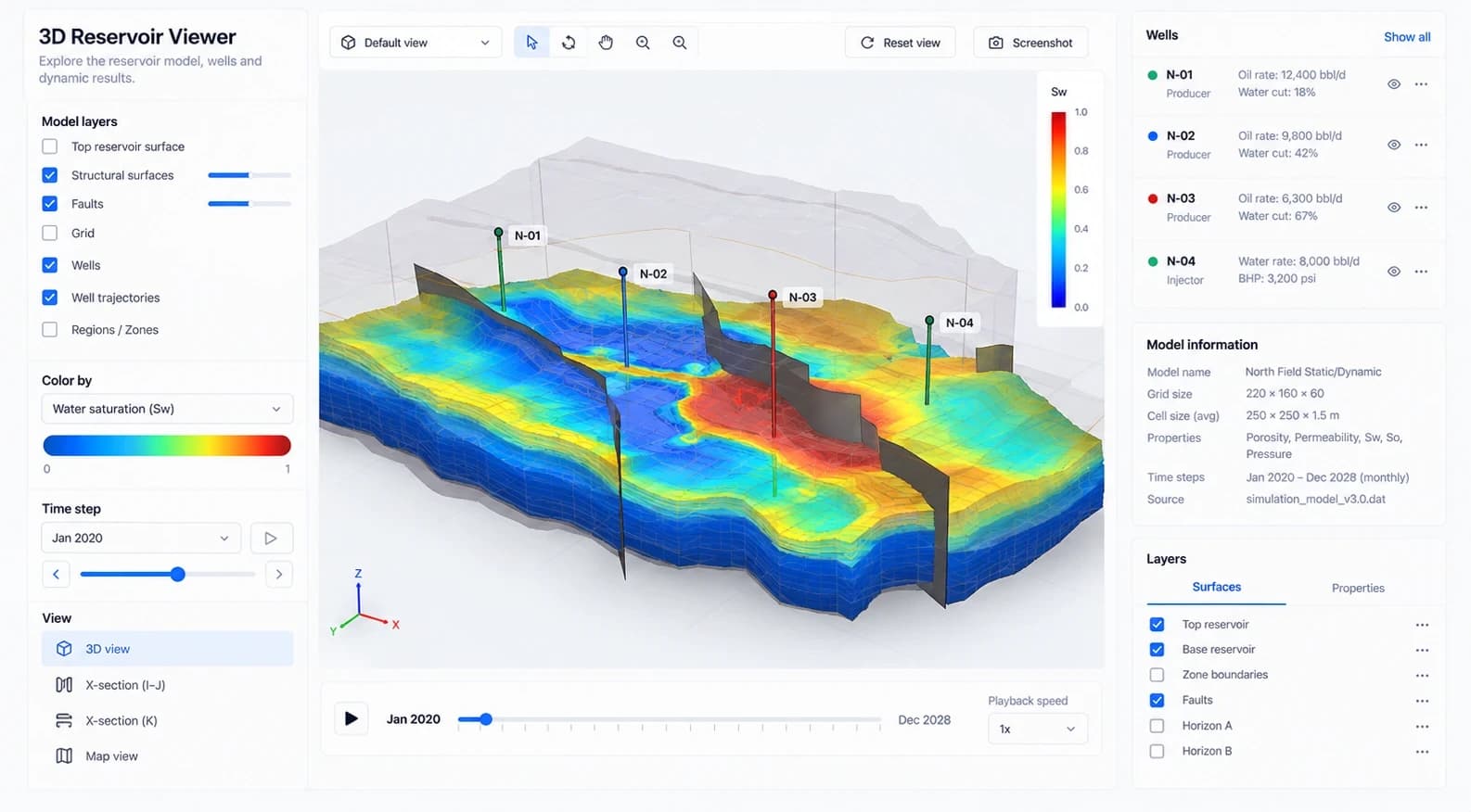
A thin, bright layer sits near the base of the reservoir. Scrub the timeline and you can watch injected water run along it toward DB-7 while the rock above barely moves.
Checkpoint 1
You pick “thief zone from injector I-2” from the list of causes. Nobody tells you whether you are right. That comes at the debrief, the same way it does at work.
What is causing the drop at DB-7?
Answer locked. Graded at debrief.
Field request
It takes two sim-days to come back. It shows 80% of the water entering through the bottom 5 m of the completion, which is the evidence your Thursday answer needs.
Water entry by interval
80% of the water comes in through the bottom 5 m.
Wednesday · Twist
“Should we also cut injection on I-2?” Cutting it would slow the water, and it would also starve the wells that I-2 is holding pressure up for.
You · Tue
Early read: thief zone at the base of layer 4. Running a PLT to confirm.
Ngozi, Asset ManagerNew constraint
Partners also want to know if we should cut injection on I-2.
Checkpoint 2
A zonal shut-off on the bottom 5 m, a forecast of the new oil rate, and a clear no to cutting injection. Each answer is a number, a range or a choice the grader can score.
Action
Zonal shut-off, bottom 5 m
Oil rate after fix
1,850 – 2,100 bbl/d
Cut injection on I-2?
No, it supports DB-4 and DB-9
Debrief
It was a thief zone. You see your path next to an expert’s, the moment the two split, and why you lost a few points: the cheaper pressure survey would have told you the same thing first.
84/ 100
Your path against the expert’s
−6 efficiency: an $8k pressure survey would have separated the hypotheses before the $60k log.
Ngozi, Asset Manager
Delta Basin Energy · Mon 08:12
DB-7, need an answer before Thursday
DB-7 has gone from 2,400 to 1,300 bbl/d since March and the water cut has jumped.
Partners meet Thursday. Reservoir or well, and can we fix it?
N.
A kick at 02:40 on a deep gas well. Shut in, read the gauges, write the kill sheet.
Twelve gas-lifted wells, one compressor down. Decide who gets the gas.
Pressure is building on the B annulus of a 20-year-old platform well.
A new tieback doubles the water into a separator sized for half of it.
Workspaces
Each workspace stands in for a tool a working engineer uses, from the well planner to the nodal bench. You do the same work in PetroLabb’s own tools in the browser, so nothing needs a licence or a cracked copy.
Briefings and pings from managers, checkpoint answers, the budget and the clock.
Stands in for Outlook, Teams
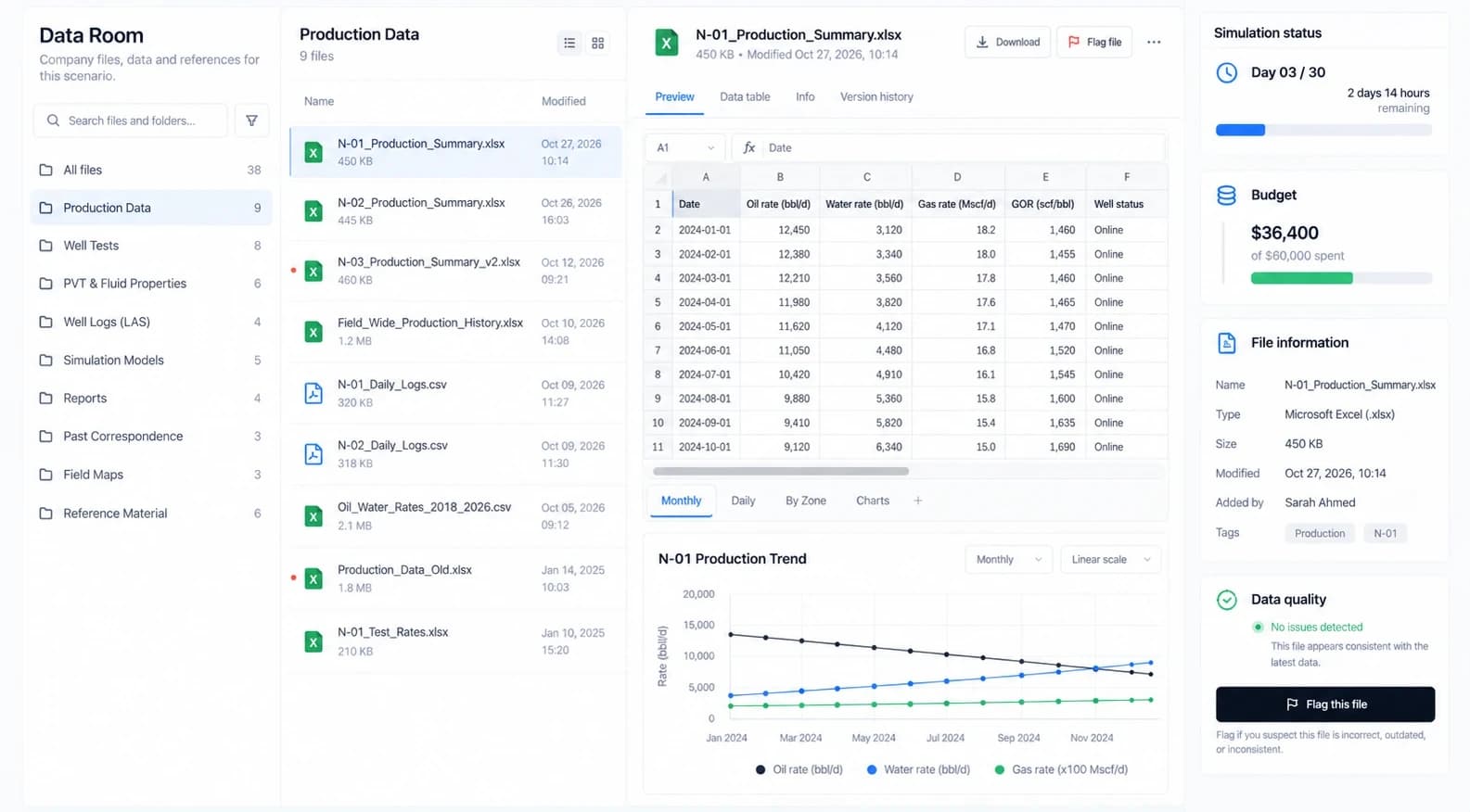
Company files, logs and reports, some of them wrong. Flag the bad ones.
Stands in for SharePoint, project databases
Python with the problem’s data already loaded.
Stands in for Jupyter
Order a log, a test or a sample. Results arrive later and cost money.
Stands in for Service company call-out
Red-pen someone else’s design, model or report.
Stands in for Peer review
Mud weight window, casing points, trajectory, torque and drag.
Stands in for WellPlan, Compass
Read the shut-in pressures, build the kill sheet, choose the method.
Stands in for Well control simulators
Sand control, perforating, tubing stress and frac design.
Stands in for WellCat, StimPlan
Barrier diagrams, annulus pressures, bond logs, abandonment plans.
Stands in for Integrity management systems
Correlate wells, pick tops and net pay, compute saturation.
Stands in for Techlog, Interactive Petrophysics
Decline, Chan WOR, Hall, P/Z, VRR and bubble plots.
Stands in for OFM, Spotfire
Tank model, aquifer, Havlena-Odeh, STOIIP.
Stands in for MBAL
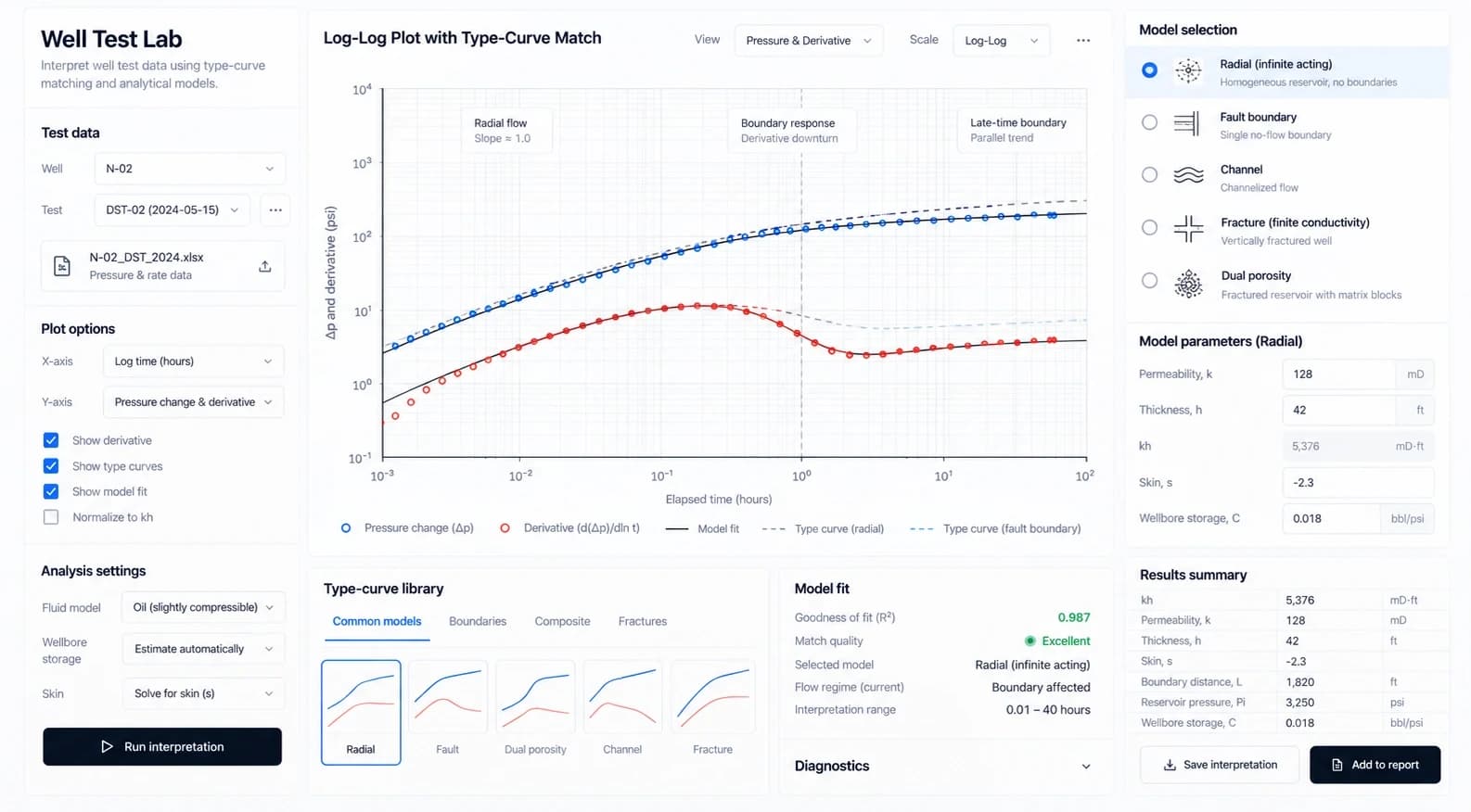
Log-log derivative, type-curve match, kh, skin, boundaries.
Stands in for Saphir
Edit, run, compare to history, all on a run budget.
Stands in for Eclipse, CMG, tNavigator
Peel layers, colour by property, scrub through time.
Stands in for Petrel, ResInsight
Inflow and outflow curves, operating point, sensitivities.
Stands in for PROSPER, PIPESIM
Gas lift spacing, ESP and rod pump sizing.
Stands in for PROSPER, vendor tools
Separator sizing, hydrate and wax checks, line sizing.
Stands in for HYSYS, OLGA
Cash flow, NPV, decision trees, PRMS booking.
Stands in for PEEP, Excel
Defend your answer to a CFO, a partner or a sceptical superintendent.
Stands in for Real meetings
The truth revealed, your path against an expert’s, the score breakdown.
Stands in for Nothing. It only exists here.
Grading
Every problem is a template. A random seed fills it in differently each time you start: a different pore pressure, a different permeability, a different right answer. The truth engine keeps one copy as the answer key and hands the other to the data generator, which adds the noise, gaps and traps real data has.
Because the answer is known, about 80 to 90% of grading is plain code. It is instant, it treats everyone the same, and it costs almost nothing to run for a thousand users or a hundred thousand.
Why sharing answers fails · DRL-003, three seeds
| Seed | Mud weight | TVD | True answer |
|---|---|---|---|
| A | 12.5 ppg | 10,000 ft | 6,500 psi |
| B | 11.2 ppg | 8,700 ft | 5,067 psi |
| C | 14.1 ppg | 12,300 ft | 9,018 psi |
Same problem, three different wells. The answer that is right for your classmate is wrong for you.
A problem only sets the dials: “The answer is a number with a 2% tolerance.” A scenario does the same for each checkpoint: “Checkpoint 1 is a pick list, the answer is C.” No new grading code is written per problem.
Numbers and ranges against the hidden answer.
Full marks inside a tolerance, sliding down beyond it. A range earns credit for catching the truth and loses some for being too wide.
Casing points, lift methods, wells, workovers and bids.
Your decision is run through the true well or field and compared with the best decision anyone could have made.
The log of everything you did.
Did you open the right files, catch the bad data, and avoid paying for tests that could not tell your hypotheses apart?
Memos and meeting replies.
A rubric: a clear answer, the drivers named, honest uncertainty, a concrete next step. Experts review a sample to keep it honest.
Your profile
A CV says what you studied. A PetroLabb profile answers the question an interviewer is really asking: what real problems has this person faced, and how well did they handle them?
Problems and scenarios solved
By discipline and difficulty, so breadth and depth both show.
A competency radar
Diagnosis, numbers, decisions, efficiency and communication, built from graded work.
Replays you choose to share
An employer can watch how you worked, not just the score you got.
A match against any job advert
Paste the advert and see which scenarios would close the gap.
You control what is public. Nothing goes to an employer unless you say yes.
Adaeze O.
Graduate engineer · Drilling and production
148
problems · 6 scenarios
78%
match to pasted advert
Who it is for
Final-year and postgraduate petroleum, chemical, mechanical and geoscience students, graduates, trainees and engineers moving between disciplines. Get real problems before your first job and a profile to show for them.
Create a free accountSet problems and scenarios as assignments, run timed contests with leaderboards, and give students industry-style work in every module without writing it yourself.
Create a lecturer accountSearch profiles by discipline, difficulty and score. Run private assessment scenarios, or send 1,000 graduate applicants one scenario and get back a ranked list backed by scored work.
Coming once profiles are worth searching.
FAQ
Anything else, ask once you are in. Your questions shape what gets built next.
LeetCode for petroleum engineering. A bank of practice problems across drilling, reservoir, production, completions, petrophysics, facilities, well integrity, geoscience, economics and data, from five-minute calculations to multi-hour field scenarios. Every answer is graded against a hidden true answer, and everything you solve builds a profile.
Final-year and postgraduate petroleum, chemical, mechanical and geoscience students, and engineers with up to about three years in the job, including people moving between disciplines. Universities and SPE student chapters can use problems as assignments and contests.
Drilling, reservoir, production, completions, petrophysics, facilities and flow assurance, well integrity, geoscience for engineers, economics and reserves, and data and Python. Each has problems at Easy, Medium and Hard, tagged by the role they prepare you for.
A problem is one question with the data you need, graded on submit, usually in 5 to 30 minutes. A scenario plays out like a week at an oil company: a vague request, a data room, a budget, a twist and a debrief. It takes a few hours and is graded at several checkpoints.
No. Each problem names the tool a working engineer would reach for, and you do the same work in PetroLabb’s own tools in the browser. Nothing needs a licence.
Wells and fields are generated, or built on public datasets such as Volve, Brugge, the Egg model and UNISIM, then disguised. The companies in problems are fictional. No operator’s confidential data is used.
Because the platform generates each well or field itself, it always holds the true answer. Most grading is plain code that compares your numbers, decisions and process with that truth, so it is instant and the same for everyone. Written memos are graded against a rubric in the paid tier.
Not usefully. A random seed changes the inputs for each player, so the mud weight, the depth, the permeability and the right answer all move. An answer that is right for your classmate is wrong for you.
No, and it does not claim to. It shows which problems you have faced and how well you handled them, which is the part of experience a CV cannot show.
Making an account is free, and the free tier includes a set number of problems each month. A paid tier adds the full bank, scenarios, memo grading and full debrief replays.
Free account
Make an account, pick a discipline and solve your first problem in five minutes.